





Safe Steps For How To Withdraw Money From Duelbits
The first useful habit is simple: slow down before you tap the cash-out button. Many payment issues do not start at the end of play - they start earlier, when a user skips profile details, forgets what method was used for funding, or leaves an unfinished verification step in the account area. If you are using Duelbits in Canada, it helps to treat the process like a checklist rather than a lucky click.
Imagine you finish a late session, see a good balance, and want the funds out immediately. Most players in that moment go straight to the cashier, but the smarter move is to review the account first. Check personal details, confirm that the payment route is still active, and make sure the balance is actually available rather than tied to an open requirement or a pending review.
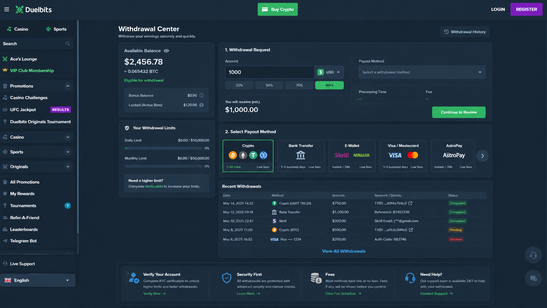
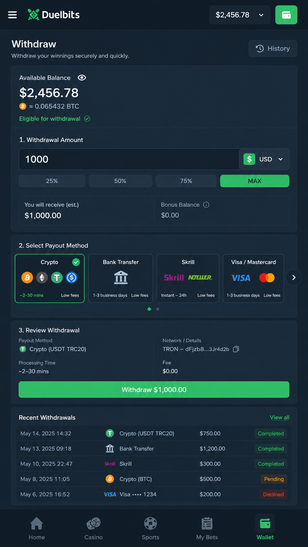
In practical terms, the flow is usually clear. Open the cashier area, choose a supported payout method, enter the amount, and confirm the request. After that, watch the account history, read any message shown inside the cashier, and respond quickly if support asks for extra confirmation.
Verify Your Profile Before Requesting Funds
Before sending any payout request, make sure the account can clearly prove who you are. The name on the profile should match the payment method, contact details should be current, and any requested documents should already be uploaded in a readable format. Players often lose time not because the platform is slow, but because the review team has to ask for something twice.
Picture a user who changed a phone number last month and never updated the account. Everything may look fine until a security check starts, and then the whole process pauses over one missing detail. Cleaning up the profile before a cash-out is faster than correcting it in the middle of one.
Check Your Method Before You Confirm
A second step is to match the payout route with the way you usually manage money. Some players prefer crypto movement, others like cards, and some lean toward wallet-style solutions when available. What matters is whether the method is active, verified, and convenient once the funds arrive.
If you deposited with one option and plan to receive funds somewhere else, there may be an extra review layer. Imagine someone funding the account quickly from a mobile device, then trying to cash out later to a different destination. That does not always create a problem, but it can trigger more questions, so consistency is usually the safer path.
Canada Payout Flow And Session Planning
For users in Canada, the most practical approach is to think about payouts before the session starts. Many adult players only think about cashing out after a winning run. A better routine is to decide the likely amount, the preferred route, and the point where you stop playing and move the balance out.
Imagine you hit a target after a few strong rounds and feel tempted to keep going because the balance looks healthy. Many players do exactly that, and the amount that was ready to leave the account gets recycled into another session. Setting a stop point in advance keeps decisions cleaner and makes the next steps easier.
The table below shows a practical way to compare common payout planning factors.
Payment Route | What Players Usually Need | Review Intensity | Speed Pattern | Best Use Case |
|---|---|---|---|---|
Bank card | Matching personal details and active card status | Moderate | Often steady, sometimes slower after checks | Familiar everyday banking |
Digital wallet | Confirmed wallet access and account identity match | Low to moderate | Often smoother for frequent online users | Flexible online spending |
Crypto transfer | Correct wallet details and careful copy-checking | Moderate | Can feel fast once released, but depends on network conditions | Users comfortable with digital assets |
Bank transfer | Accurate banking information and patience | Moderate to high | Commonly slower but predictable | Larger sums and standard account routing |
Another useful detail is emotional timing. Do not manage a payout when tired, rushed, or annoyed after a loss. If you are frustrated, you are more likely to type a wrong amount, miss an on-screen message, or choose the wrong destination.
Common Questions About How To Get Money On Duelbits
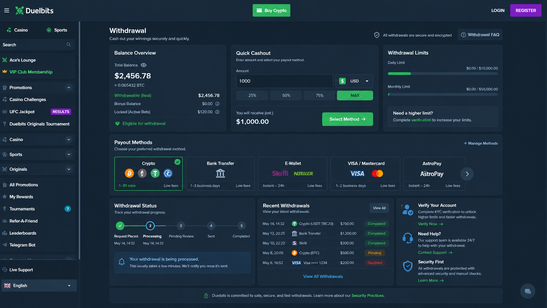
When players ask how they actually receive funds, they are usually asking three things at once: where the request is made, what happens after confirmation, and when the money becomes usable on the chosen method. The request is the easy part. The wait begins after, when the account, transaction route, and security logic do their work in the background.
Think of a player who has never taken money out before. The balance is there, the cashier is open, but the real uncertainty is psychological: did the request go through, should anything else be clicked, and is it normal not to see instant movement? In most cases, the best next step is not to keep resubmitting. It is to check the transaction history once, read the status label, and leave the request alone unless the platform specifically asks for action.
Keep simple records. Save the request amount, note the time, and remember which route was selected.
What Usually Happens After The Request
After confirmation, the request often moves through a short internal chain: queued, reviewed, approved, and then released to the external method. Not every stage is visible to the user, which is why patience matters. A blank moment does not automatically mean a problem.
Imagine checking the account ten minutes later and seeing no change in the receiving app. Many users assume something failed and try again. Usually, that is unnecessary. A better routine is to wait for the status to change in the cashier first, then give the selected method reasonable time to process the incoming transfer.
What A Duelbits Withdraw Usually Involves
A payout request is not only about moving money. It is also about matching account history, method logic, and internal risk checks. That is why the cleanest requests are often the ones prepared long before the balance is ready to leave. If your profile is consistent and your chosen route makes sense for your past activity, the whole experience tends to feel smoother.
Consider a user who keeps one method for funding, one method for receiving, and one stable device for account access. Nothing fancy is happening, but that predictability helps. Compare it with a situation where the user switches devices, locations, and methods within a short period - extra review becomes more likely, even if everything is legitimate.
Bonus conditions, if any were accepted earlier, may affect what part of the balance can actually be removed. Reading the account terms at deposit helps prevent surprises.
Choosing A Method That Matches Your Deposit Habit
Method matching is one of the most practical ideas in online gaming payments. If your account history shows one consistent route, support and payment systems have less to question. This does not mean you can never use another option, but stable behavior usually reduces friction.
Picture someone who funds the account with a card, plays for a week, then decides to receive the full balance through a completely different channel without checking whether it fits that pattern. The request may still go through, yet it can take longer because more review is needed. Players who want fewer surprises usually keep their funding and payout habits aligned.
Responsible Play Tools And Account Control
A good cash-out process is not only technical - it is behavioral. The player who handles money best is usually the one who knows when to stop, when to cool off, and when to step away briefly. Duelbits, like other modern platforms, may provide account control tools such as breaks, limits, or reduced access periods. Even when those tools are simple, they can protect a winning balance from turning into another session.
Imagine you finally reach the amount you wanted, but a few minutes later you start thinking, "Maybe one more round." That is the moment where discipline matters more than luck. Users create rules: cash out a portion first, leave only a smaller entertainment balance behind, and log out once the request is submitted.
For adult players in Canada, this approach fits safer play. Use a budget, decide session length in advance, and do not treat every balance as money that must stay in action.
When A Break Is Smarter Than A New Session
There are moments when the best move is not another spin, another bet, or another attempt to recover a dip. It is a pause. If emotions are running high, making payment decisions at that moment usually leads to messy outcomes.
Imagine ending a rough session and immediately trying to rearrange balances while annoyed. Usually, that is when mistakes happen. A short timeout, even just overnight, often creates a clearer view of what should stay in the account and what should leave it.
What Duelbits Withdrawal Time Depends On In 2026
Players love one simple answer about speed, but real payout timing is shaped by several moving parts. The chosen route matters. Account readiness matters. Manual review matters. Even the hour or day of the request can matter, especially if you submit close to a heavier queue period. In 2026, the practical expectation is not "instant every time" but "faster when the account is clean and the method is familiar."
Imagine two users sending the same amount on the same evening. One has a fully checked profile, a consistent payment pattern, and no open bonuses. The other has recent profile edits, a new device, and a request to an unfamiliar destination. They may not move through the system at the same pace, even if both did everything honestly.
That is why it helps to separate platform review from method arrival. First, the request needs approval on the account side. Second, the receiving channel must reflect the transfer. Players sometimes combine those steps in their head and think the entire process is stuck, when in reality the first half is done and the second is simply moving at the normal pace for that route.
If you want the smoothest experience, submit the request carefully once, avoid repeated cancellations, and keep a record of what you did. Repeated edits can slow a simple process.
Support Review, Queue Times, And Timing Expectations
Support is most useful when you contact it with a specific question, not just a general feeling that something is slow. State the amount, the method, the time of request, and what the status currently shows. That gives the team something concrete to work with and reduces back-and-forth.
Picture a player opening chat with only "Where is my money?" It is understandable, but not very useful. Compare that with a message that explains the route chosen, when the request was made, and whether any verification prompt appeared. The second version usually gets a more practical answer.